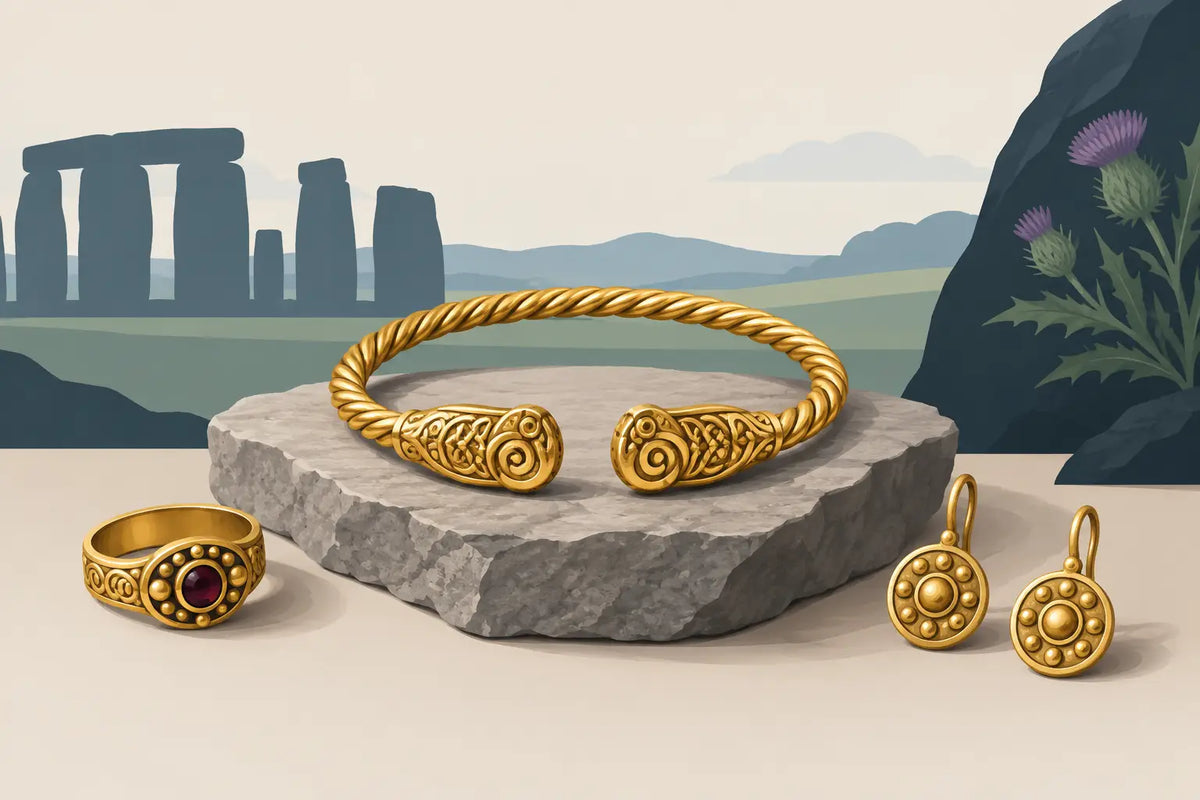
Why Choose Jewellery Cast from Original Artefacts
A ring copied from a thousand-year-old find is not simply historic-looking. Jewellery cast from original artefacts begins with the form, proportion and surface character of an object made and worn in Britain centuries ago. The slight asymmetry of an early medieval band, the confident curve of a Roman setting or the interlaced rhythm of a Celtic design carries more meaning than a modern interpretation ever could.
For those drawn to archaeology, this is the distinction that matters. A reproduction inspired by the past may borrow a motif. A piece cast from an original artefact retains a direct visual relationship with a specific object, period and place. It makes Britain’s material history present at the hand, neckline or ear, while allowing the original find to remain protected as part of the archaeological record.
What Jewellery Cast from Original Artefacts Preserves
An archaeological jewel holds evidence beyond its decorative pattern. Its shape reflects the techniques available to its maker, the fashions of its community and, sometimes, the status or beliefs of its owner. Casting from the original preserves details that are easily softened or lost when an object is redrawn: a finely raised border, a tool-mark, the depth of an engraved line or the particular profile of an old bezel.
That fidelity gives a reproduction its quiet authority. Rather than claiming to be antique, it is honestly made in the present, with a known connection to the past. It can be worn without the anxiety that accompanies a fragile original, while still honouring the design language of the era from which it came.
Provenance is central to this relationship. Knowing that a form originates in Roman Britain, an Anglo-Saxon burial, a Viking-period settlement or a medieval hoard changes how it is seen. The original find location anchors the design in a real landscape, not an imagined version of history. A pendant becomes more than an attractive object; it becomes a small, wearable encounter with a particular chapter of Britain’s past.
From Original Find to Finished Jewel
The making of an artefact reproduction requires both restraint and skill. Direct casting captures the original form, but the resulting piece is only the beginning. A jewel intended for regular wear must be carefully prepared, refined and finished by hand. Edges need to feel considered against the skin, surfaces need to be polished or selectively aged, and proportions may require thoughtful adjustment where the historic object was damaged or incomplete.
Precious metal, chosen for a modern life
Sterling silver often suits the crisp detail of historical designs and offers a bright, enduring setting for everyday wear. Gold brings warmth and permanence, particularly to rings chosen for engagements, weddings or anniversaries. Platinum is valued for its density, pale lustre and exceptional durability. The right choice depends on both the artefact and the person who will wear it.
A finely detailed Roman ring may appear particularly striking in yellow gold, while silver can underline the sculptural lines of a Viking knotwork pendant. For a wedding band, gold or platinum may be the practical preference, especially for a piece worn every day. There is no single correct metal, only the right balance of historic character, personal taste and intended use.
Selected designs can also be set with gemstones. Carnelian has a natural affinity with Roman jewellery, recalling the warm red-orange stones used in ancient seals and rings. Rubies, emeralds and sapphires bring a more formal richness to certain historic forms. A gemstone should complement the original design rather than overwhelm it. The most successful setting makes the historical source feel clearer, not merely more ornate.
The assurance of hallmarking
A historic design deserves modern accountability. Precious-metal jewellery should carry the confidence of independent assay, confirming the fineness of the metal from which it has been made. London Assay Office hallmarking provides that assurance, pairing centuries of British craft tradition with a clear standard for the wearer.
Each piece also benefits from individual hand-finishing. Casting is capable of reproducing form, but it cannot replace the judgement of a maker. The final work lies in bringing definition to recessed detail, balancing a ring on the finger, securing a stone and achieving a surface that looks purposeful rather than factory-perfect.
Why Provenance Matters More Than Style Alone
Historical style has become familiar in contemporary jewellery. One can find generic knotwork, broad "medieval" bands and loosely Roman motifs almost anywhere. Their appeal is understandable, but their relationship to the past is often vague. Without a documented source, a design may be evocative, yet it cannot tell a precise story.
Jewellery with a stated period and original find location offers something more lasting. It invites questions: who made the original, what did the symbol mean, and how did it travel through time to be found again? These are not decorative details. They shape the significance of a gift, a personal talisman or a wedding ring exchanged at the beginning of a shared life.
This is especially meaningful for collectors and for those with a connection to a region, historic era or faith tradition. A Christian cross informed by an early devotional object can be worn as an expression of belief as well as heritage. A Celtic pendant may speak to family roots. An Anglo-Saxon or Viking ring can appeal to someone fascinated by the complexity of early Britain rather than a simplified legend of it.
British Historical Jewellery approaches this work as custodianship as much as manufacture. The aim is not to turn archaeology into costume, but to give historic forms a considered continuation in precious metal.
Choosing an Artefact Reproduction to Wear
Begin with the history that genuinely holds your attention. Roman designs often have an architectural clarity: strong bezels, engraved motifs and compact silhouettes. Celtic work is recognised for its flowing interlace and symbolic rhythm. Viking-period jewellery can be bolder, with animal forms, braided patterns and confident texture. Anglo-Saxon and medieval pieces may feel more intimate, shaped by devotional practice, trade and changing ideas of rank and identity.
Then consider how the jewel will live with you. A substantial ring makes a compelling statement but may suit occasional wear better than a low-profile band. Earrings and pendants allow intricate detail to be appreciated without the knocks of daily hand use. If the piece marks an engagement or marriage, comfort, width and metal choice deserve as much attention as the archaeological source.
It is also worth accepting that faithfulness has its own character. Historic originals were made by hand, and many survive with irregularities, wear or slight variations in pattern. Those qualities are often what make a reproduction persuasive. Perfect symmetry can be handsome, but it may not be the most truthful response to an artefact created long before industrial standardisation.
A Living Connection to Britain’s Past
To wear an artefact reproduction is to choose continuity over novelty. The original object remains where it belongs: preserved, studied and valued as evidence of the people who came before us. Its form, however, can continue to speak through a new piece made for the present.
Whether chosen as a personal ring, a gift with a story, or a wedding jewel intended to gather its own history, the best reproductions ask for more than admiration. They invite care. Worn thoughtfully, they become a modest but tangible reminder that Britain’s past is not distant - it is still held in the shapes we choose to carry forward.