Article: A Ring Worn for a Dead King: the Royalist Memorial Ring for Charles I
A Ring Worn for a Dead King: the Royalist Memorial Ring for Charles I
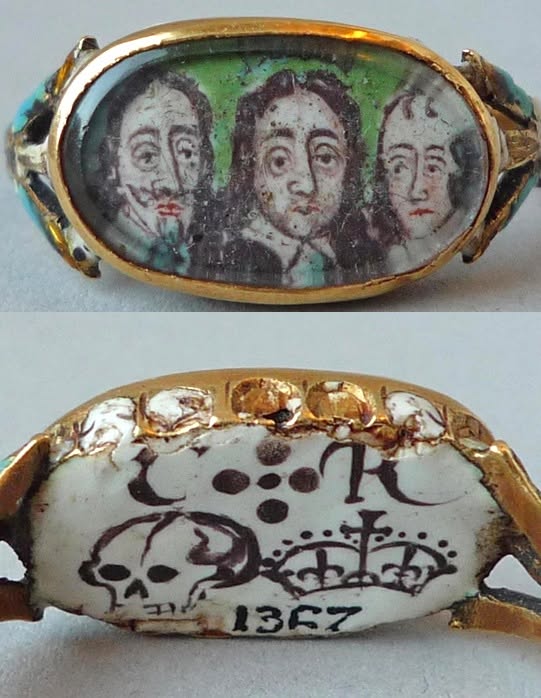
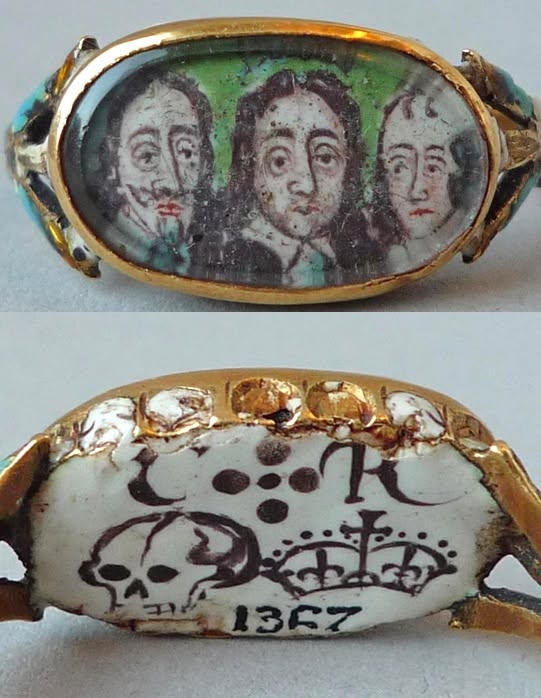
Some small objects carry a whole political story. This one is a gold ring from the 17th century. In its oval bezel, under glass, sit three tiny enamelled portrait busts on a ground of pale blue and green. Turn the ring over and the back is white enamel painted with the letters C R, a crown and a skull.
It is a memorial to Charles I, who was executed on 30 January 1649. Here is what we can say about it, the few puzzles it sets us, and how a Stuart goldsmith possibly made it, told the way we would explain it at the bench.
What is on the ring
The front is an oval bezel about 14 mm long. Behind a cover of crystal glass, three heads sit side by side. The one on the left seems to have the pointed beard we know from portraits of the king. The other two look beardless. The faces are simple and slightly stiff, with a few dark lines for hair and eyes and a touch of red on the lips. The shoulders of the hoop are pierced with openwork and enamelled in pale blue and white.
On the back, in brown on white enamel, are the letters C R for Carolus Rex (King Charles), a crown, and a skull. A skull on a ring is a memento mori, a reminder of death. Together, the crown and skull say that a king has died.
This reverse is a familiar one. The V&A has a mid 17th-century gold ring with a miniature of Charles I whose back carries a white enamelled skull below a crown, between the letters C and R. The London Museum has a gold memento mori ring of about 1649 to 1650 with a skull flanked by the initials C R. A crowned skull with the king's cipher looks to have been a standard way of mourning him.
There is also a number, 1367, painted in black on the white enamel. At first glance it looks like a date, but it is not one that fits the story, so we give it a section of its own below.
Is it in a museum?
Very probably, though we cannot prove it from the museum's own website.
The British Museum's finger-ring catalogue by O. M. Dalton (1912) lists a ring as number 1367. It is gold, with pierced shoulders enamelled in pale blue and white, and an oval bezel with portrait busts of Charles I and two beardless figures in enamel under glass, on a ground of pale blue and green. The back is white enamel with the letters C R, a crown and a skull in brown. That matches what we can see on this ring, point for point. Christie's, in a lot essay, cites the same catalogue entry as a ring in the British Museum's collection, and reads the three heads as Charles II between his father Charles I and his mother Henrietta Maria. Dalton only says "two beardless personages", so we would call that one reading, and a reasonable one, rather than a certainty. We come back to the sitters below.
We could not open a British Museum online record for it, so we cannot give you its museum number. The painted "1367" may be Dalton's catalogue number, but that is our reading, and it matters for the date, as we explain below. For now, we will say only that this ring matches the British Museum's catalogue entry 1367.
Reading the ring
Two things on this ring invite questions: who the three faces are, and what the number on the back is telling us. Nothing on the ring answers either, so what follows are readings, not records.
Who are the three faces?
One reading is the one Christie's gives for the British Museum ring: Charles II in the middle, between his father, Charles I, and his mother, Queen Henrietta Maria. A queen would be beardless, which fits Dalton's "two beardless personages", and the pointed beard on the left would suit the king.
Another reading is that the left-hand figure is Charles I and the other two are his sons, Charles, the future Charles II, and James, Duke of York. That would be a neat message for a Royalist to wear: the martyred king beside his heirs, the royal line carried on in miniature. One objection is that you might expect the king to be in the centre, and here he is at the side.
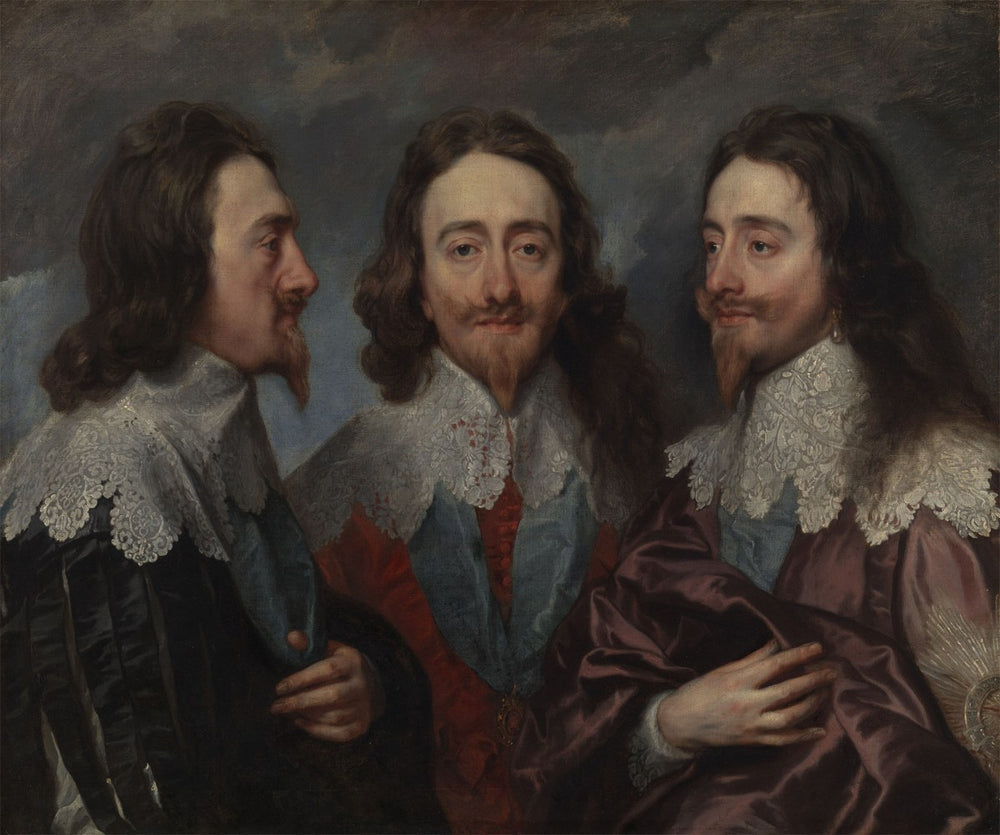
It is also sometimes suggested that the trio echoes Van Dyck's Charles I in Three Positions. That painting shows one man from three angles. It was made in 1635 to 1636 so that the sculptor Bernini could carve a marble bust of the king without travelling to England. On our ring the three heads do not look like one man seen from three sides, so if Van Dyck's picture was in the goldsmith's mind, it may have given him the idea of a trio, and little more. At about 14 mm across, with a few dark lines for hair and eyes, the faces will not settle the question on their own.
What does 1367 mean?
Read as a year, 1367 sits in the reign of Edward III, nearly three centuries before the king this ring remembers. So if it is a date at all, something has gone astray.
One possibility is that it is not a date. As we said above, 1367 matches the British Museum's catalogue entry for a ring of this design, and a number painted on later by a collection or a cataloguer would explain why it sits oddly on the back.
If it was meant as a date, there are a few ways to read it. A 6 can look like a 3, especially when it is hand-painted tiny on enamel or has worn with age, so 1667 is one idea. That would put the ring in the Restoration, when Charles was remembered as King Charles the Martyr and the day of his death was kept as a day of fasting and humiliation, according to the V&A. Another idea is 1637, which would be before the war and the execution, and would suggest an older ring given a new back later. It may also be that a digit was mis-cut or altered long after the ring was made.
Dates on Charles memorials can also look wrong when they are not. A London Museum memorial medallion has a crown, the letters C R and a skull flanked by the numbers 16 and 48. The year was not a mistake. In the old calendar the new year began on 25 March, so the January of Charles's execution was still counted as 1648 by people at the time. That does not explain 1367, but it is a good reason to be careful with dates on rings like this.
It is also fair to ask, of any ring like this, whether every part of it is as old as the rest. Memorial rings were remade, reset and added to over the centuries, and we have not handled this one. Looking at the enamel and glass under magnification, and analysing them, is how that question would be settled. A photograph cannot do it.
Why it was made, and who wore it
A ring like this was a quiet statement of loyalty. According to Christie's, before the Civil War Henrietta Maria gave rings, lockets and slides with the king's portrait to people who lent money to the Royalist cause. After the execution, the V&A tells us, portraits, locks of hair and royal symbols were set into rings and worn as a sign of allegiance. Wearing one could be dangerous under the Commonwealth, so many may have been hidden until the Restoration in 1660, and many more were made after it.
So the likely wearers were Royalist supporters: people who had backed the king, people who mourned him, and later those who wanted to be seen as loyal to his son, Charles II. The V&A and Christie's both note that Stuart portrait rings were still worn long afterwards, as a political badge by Jacobites. We cannot say who owned this particular ring, and nothing on it names a wearer.
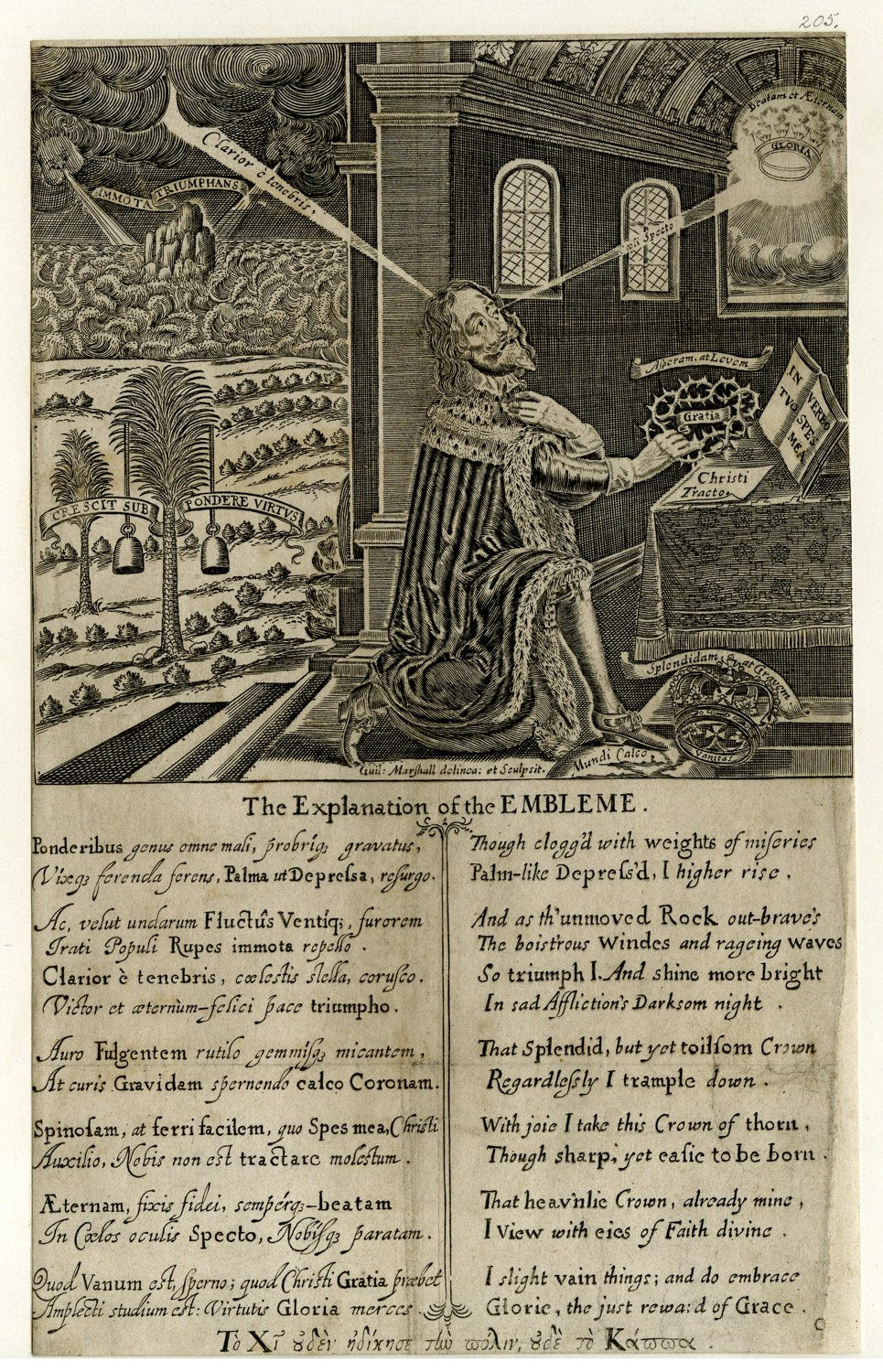
Charles was remembered as a martyr. On the scaffold he spoke of going "from a corruptible to an incorruptible crown, where no disturbance can be." The Royal Collection says that many of these enamel portraits, made between 1649 and 1660, were "generally of poor quality", produced quickly for followers of the cause. These were badges as much as portraits. People wanted a way to remember.
The crown and skull on the back may be read alongside those words: an earthly crown, and death, with the heavenly crown beyond. That is one reading, and we cannot say that any goldsmith or wearer had the scaffold speech in mind, but the Eikon Basilike frontispiece above shows the same idea, with a worldly crown at the king's feet and a heavenly one above him.
The British Museum catalogue groups this ring with a run of "Stuart rings" worn by adherents of the royal house. Several of them carry the same C R, crown and skull on the back.
How it was possibly made
We have not handled this ring, so please read this as how a goldsmith in the 17th century could have made it, not as a record. It is based on the object and on what museums tell us about the techniques.
1. The gold. The hoop could have been hammered from a strip and bent round, or cast and cleaned up. We cannot tell which from a photograph. It is a light ring: Dalton gives the weight as 43 grains, under 3 grams.
2. Piercing the shoulders. The openwork was probably drawn on the metal, then holes drilled and a fine saw threaded through to cut out each shape. The V&A describes piercing in just that way, one opening at a time. The edges would be filed smooth, and perhaps chased to add detail.
3. Making the bezel. An oval wall of gold strip would be soldered to a flat back plate to make a shallow box, then joined to the hoop. Dalton notes a band of flutes round the edge, which would have been shaped before any enamel went on.
4. Enamel on the shoulders. The pale blue and white could be powdered glass fired into recesses cut in the gold, the way champlevé enamel is made. The exact method here is our guess.
5. The portraits. This is the hardest step. Painted enamel miniatures were developed in France in the 1630s, and Jean Petitot worked in both the French and English courts. The V&A describes the method: a thin gold plate is covered in white enamel and fired. Powdered coloured glass and metal oxides, mixed with oil, are painted on in thin layers, with a firing after each colour. The colours that need the most heat go on first, and the back of the plate gets a layer of counter enamel so it does not warp. Every firing risks ruining the picture, so each colour had one chance. With three faces in a bezel about 14 mm long, that is fine work, done by eye and by long practice.
6. The back. The white reverse was probably painted and fired in the same way: a crown, a skull and the letters C R in brown oxide.
7. Setting the glass. Only when all the enamel was finished would the goldsmith set the cover. This is crystal glass, cut or ground to the oval and held by pressing the thin gold rim of the bezel over its edge. It would have gone in last because the heat of the enamel firings could crack it, and it protects the portraits from knocks and damp.
One thing to bear in mind: lead crystal glass is usually dated to the late 1670s. If this cover really is lead crystal glass, that would suggest the ring was made, or reglazed, later in the 17th century than 1649. Only a scientific analysis of the glass could say.
8. Finishing. The last job was to clean and polish the gold, carefully, with the enamel and glass already in place.
What the ring cannot tell us
We cannot say who made it, who wore it, or exactly when. The sitters, the number on the back, the glass and the techniques above are possibilities, not records. What we can say is that it is a small, personal object from a time when showing loyalty to a dead king could cost you dearly, made with real skill.
You can see similar rings in the online catalogues of the London Museum, the Royal Collection and the V&A. Our museum pages are where we will keep collecting stories like this one.
Sources
- O. M. Dalton, Catalogue of the Finger Rings, Early Christian, Byzantine, Teutonic, Mediaeval and Later (British Museum, 1912), no. 1367, p. 197, and the note on nos. 1359 to 1375: full text on the Internet Archive
- Christie's, Four gold memorial rings for Charles I, Charles II and William III (lot essay citing Dalton no. 1367 as in the British Museum, and the background on Henrietta Maria's rings)
- Royal Collection Trust, Gold ring with a miniature of Charles I
- V&A, Commemorative ring with a miniature of Charles I, mid 17th century (M.145-1962: white enamelled skull below a crown between C and R)
- London Museum, Charles I memento mori medallion (16 and 48, and the old-style calendar)
- Royal Collection Trust, Charles I in Three Positions, Anthony van Dyck
- Charles I's scaffold speech, 30 January 1649: King Charls his Speech (contemporary pamphlet text), and Historic Royal Palaces, Banqueting House
- V&A, Royalist commemorative ring, mid 18th century
- London Museum, Charles I memento mori ring
- V&A, Portrait miniatures painted in enamel
- V&A, A guide to metalworking techniques
- Historic England, The 'Invention' of Lead Crystal Glass, and V&A, Drinking glass by George Ravenscroft